
Chair of Applied Mathematics (Continuous Optimization)
Head of Chair

Prof. Dr. Michael Stingl
Chair of Applied Mathematics (Continuous Optimization)
Professors
Address
Contact
Team Assistant/Secretary
Nicole Güthlein
Chair of Applied Mathematics (Continuous Optimization)
Team assistant/Secretary
Address
Contact
Scientific Team
Dr. Fabian Wein
Chair of Applied Mathematics (Continuous Optimization)
Research associates
Address
Contact

Dr. Lukas Pflug
FAU Competence Center Scientific Computing (FAU CSC)
Research associates
Address
Contact
Dr. Dieter Weninger
Chair of Applied Mathematics (Continuous Optimization)
Research associates
Contact
Nico Nees
Collaborative Research Center 1411/2 Design of particulate products
Research associates
Address
Contact
Adeel Muneer
FAU Competence Center Scientific Computing (FAU CSC)
Research associates
Dr. Andrian Uihlein
Chair of Applied Mathematics (Continuous Optimization)
Research associates
Address
Contact
Jakob Rodestock
FAU Competence Center Scientific Computing (FAU CSC)
Research associates
Address
Contact
Florian Prohaska
Collaborative Research Center 1411/2 Design of particulate products
Research associates
Address
Contact
Max Zetzmann
Research Training Group 2423/2 - Fracture across scales: Integrating mechanics, materials science, mathematics, chemistry, and physics
Research associates
Address
Contact
Dr.-Ing. Sukhminder Singh
Collaborative Research Center 1411/2 Design of particulate products
Research associates
Address
Contact
Former Members
| Dr. Lennart Igel |
| Dr. Bich Ngoc Vu |
| Dr. Alexander Keimer |
| Dr. Jannis Greifenstein |
| Dr. Arefeh Kavand |
| Dr. Daniel Hübner |
| Hamzah Khan |
| Christoph Geist |
| Thomas Guess |
| Dr. Johannes Semmler |
| Dr. Stefan Werner |
| Dr. Christoph Strohmeyer |
| Dr. Tobias Kufner |
| Dr. Fabian Schury |
| Dr. Bastian Schmidt |
Current Projects

DFG Research Training Group 2423 FRASCAL
PI, P11: Fracture Control by Material Optimization
Co-PI, P10: Configurational Fracture/Surface Mechanics
GRK 2423: Fracture across scales
Spokesperson: Prof. Dr.-Ing. P. Steinmann (Erlangen)
DFG Collaborative Research Centre 1411
Design of Particulate Products
D05: Topology, material and shape optimisation for particle ensembles (Stingl)
D03: Unifying mathematical framework for synthesis and chromatographic separation of nanoparticles (Pflug)
INF: Information management and computational science support (Spiecker/Stingl)
CRC 1411: Design of Particulate Products
Spokesperson: Prof. Dr. N. Vogel (Erlangen), deputy spokesperson Prof. Dr. M. Hartmann (Erlangen)

The P&G SimCenter (since 2014, extended until the end of 2026)
Master Collaboration Agreement with Procter & Gamble
The collaboration gives rise to a continuous stream of smaller projects with FAU, for example master’s theses. They are organised by the FAU Competence Center Scientific Computing (CSC). Contact person at FAU: Dr. Lukas Pflug.
Completed Projects

DFG Transregional Collaborative Research Centre 154 (until 2026)
B06: Robustification of Physical Parameters in Gas Networks
TRR 154: Subprojects, phase 2
Spokesperson: Prof. Dr. A. Martin (Erlangen)

DFG Collaborative Research Centre 814
C2: Robust structural and process optimization in the context of additive manufacturing
Spokesperson: Prof. Dr.-Ing. D. Drummer (Erlangen)

EU ITN Network POEMA (2019–2022)
Polynomial Optimization, Efficiency through Moments and Algebra
Coordinator: Prof. Dr. B. Mourrain (INRIA Sophia Antipolis, Nice)
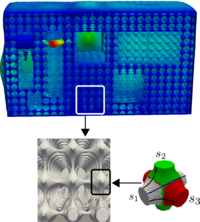
Additive Manufacturing for Aircraft (ALM2AIR)
Aviation Research Programme (LuFo) 5-2, “Optimization of components for additive manufacturing”
This project aims to advance techniques for lattice optimization in the context of additive manufacturing using titanium alloy (Ti-6Al-4V). We study the full workflow from selection of parametrized base cells for stiffness optimization, the optimization algorithm, the interpretation of optimized results as a macroscopic lattice design including predefined solid and void non-design regions, and the generation of a ready-to-print surface description of the lattice structure. For the field of structural optimization, the SGP (Sequential Global Programming) algorithm is advanced allowing the distinct choice between solid, void and lattice during the optimization process.

DFG Priority Programme 1679
Dynamic simulation of interconnected solids processes: modelling, simulation and optimization of process chains
SPP 1679: DynSim-FP
PI: Prof. Dr. G. Leugering, Coordinator: Prof. Dr. Stefan Heinrich (Hamburg)
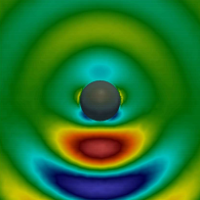
Optimization of iron oxide pigments (2012–2017)
The dependency of the optical properties of a pigment film and the shape or shape distribution of the pigment is studied within this project. Further, this dependency is used to identify regions in parameterized shape space which will lead to better color values of the pigment.
Prof. Dr. Günter Leugering (Erlangen), Prof. Dr.-Ing. Wolfgang Peukert (Erlangen), Prof. Dr. Ulf Peschel (Erlangen), Prof. Dr. Robin N. Klupp Taylor (Erlangen), Dr. Lukas Pflug (Erlangen)
Industrial Partners
e.g. Adidas, Airbus, BASF, Lanxess, Procter & Gamble, Schaeffler, Siemens
Projects in CRIS
Die CRIS-Daten sind momentan nicht verfügbar. Bitte versuchen Sie es später erneut.
Die CRIS-Daten sind momentan nicht verfügbar. Bitte versuchen Sie es später erneut.
Master’s theses
Multiscale Elasto-dynamics
Description
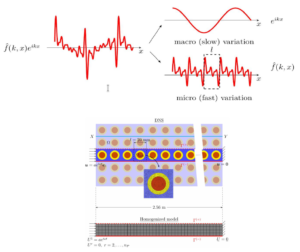
Nowadays, considerable progress is being made in the design of composite materials which can exhibit properties that are not found in naturally occurring materials. Numerical homogenization techniques are used in order to find effective properties of periodic microstructures at the macro-scale. In conventional homogenization methods, the material properties are averaged over a repeating Representative Volume Element (RVE) in order to calculate those effective properties. But in the case of elastodynamics, uniform volume averaging can lead to a loss of phase information which is necessary to accurately describe the elastodynamic material at the macro-scale. Such limitations can be overcome by transferring the microscale information to the Fourier space and then projecting the frequency modes to a reduced space composing a few selected Floquet-Bloch eigenmodes, thereby reducing the degrees of freedom at the macro-scale. The homogenized parameters can then be utilized in a material optimization setting, thus optimizing the dynamic properties of the structure.
Objective
To develop a multiscale method for elasto-dynamic simulation using homogenization in the Fourier domain.
Prerequisites
Good knowledge of numerics of partial differential equations, mathematical optimization, programming in MATLAB/Python/C++ and a lot of enthusiasm.
Language: English or German
Tasks
- Literature research
- Model development
- Numerical experimentation
- Writing thesis and dissemination of the results
Optimization of a Mechatronic Sensor
Maximizing the sensitivity and robustness of a mechatronic sensor through structural optimization.
In cooperation with a regional industry partner.
Tooth Root Optimization
Topology optimization of a tooth root. Attempt to compare evolution against structural optimization. For CE students who aren’t afraid of the dentist. 🙂
Solar Air Heater
Solar air heaters are fascinatingly simple, cheap and efficient devices for environmentally friendly ventilation and heating. Yet, solar air heaters are widely unknown in western countries.
Based on an existing numerical setup for a coupled flow/heat model, certain properties can be structurally optimized by means of gradient-based optimization.
HiWi jobs
We are constantly looking for dedicated students starting from Bachelor level to work on small scientific projects in our group. If you are interested in optimization, numerics and challenging applications and would like some income on a regular basis, please contact us. For students of mathematics and computational engineering.