
Chair of Applied Mathematics (Continuous Optimization)
Head of Chair

Prof. Dr. Michael Stingl
Chair of Applied Mathematics (Continuous Optimization)
Professors
Address
Contact
Team Assistant/Secretary

Nicole Güthlein
Chair of Applied Mathematics (Continuous Optimization)
Team assistant/Secretary
Address
Contact
Scientific Team

Dr. Fabian Wein
Chair of Applied Mathematics (Continuous Optimization)
Research associates
Address
Contact

Dr. Lukas Pflug
FAU Competence Center Scientific Computing (FAU CSC)
Research associates
Address
Contact

Dr. Dieter Weninger
Chair of Applied Mathematics (Continuous Optimization)
Research associates
Contact

Nico Nees
Collaborative Research Center 1411/2 Design of particulate products
Research associates
Address
Contact

Adeel Muneer
FAU Competence Center Scientific Computing (FAU CSC)
Research associates

Dr. Andrian Uihlein
Chair of Applied Mathematics (Continuous Optimization)
Research associates
Address
Contact

Jakob Rodestock
FAU Competence Center Scientific Computing (FAU CSC)
Research associates
Address
Contact

Florian Prohaska
Collaborative Research Center 1411/2 Design of particulate products
Research associates
Address
Contact

Max Zetzmann
Research Training Group 2423/2 - Fracture across scales: Integrating mechanics, materials science, mathematics, chemistry, and physics
Research associates
Address
Contact

Dr.-Ing. Sukhminder Singh
Collaborative Research Center 1411/2 Design of particulate products
Research associates
Address
Contact
Former Members
| Dr. Lennart Igel |
| Dr. Bich Ngoc Vu |
| Dr. Alexander Keimer |
| Dr. Jannis Greifenstein |
| Dr. Arefeh Kavand |
| Dr. Daniel Hübner |
| Hamzah Khan |
| Christoph Geist |
| Thomas Guess |
| Dr. Johannes Semmler |
| Dr. Stefan Werner |
| Dr. Christoph Strohmeyer |
| Dr. Tobias Kufner |
| Dr. Fabian Schury |
| Dr. Bastian Schmidt |
Current Projects

DFG Research Training Group 2423 FRASCAL
PI, P11: Fracture Control by Material Optimization
Co-PI, P10: Configurational Fracture/Surface Mechanics
GRK 2423: Fracture across scales
Spokesperson: Prof. Dr.-Ing. P. Steinmann (Erlangen)
DFG Collaborative Research Centre 1411
Design of Particulate Products
D05: Topology, material and shape optimisation for particle ensembles (Stingl)
D03: Unifying mathematical framework for synthesis and chromatographic separation of nanoparticles (Pflug)
INF: Information management and computational science support (Spiecker/Stingl)
CRC 1411: Design of Particulate Products
Spokesperson: Prof. Dr. N. Vogel (Erlangen), deputy spokesperson Prof. Dr. M. Hartmann (Erlangen)

The P&G SimCenter (since 2014, extended until the end of 2026)
Master Collaboration Agreement with Procter & Gamble
The collaboration gives rise to a continuous stream of smaller projects with FAU, for example master’s theses. They are organised by the FAU Competence Center Scientific Computing (CSC). Contact person at FAU: Dr. Lukas Pflug.
Completed Projects

DFG Transregional Collaborative Research Centre 154 (until 2026)
B06: Robustification of Physical Parameters in Gas Networks
TRR 154: Subprojects, phase 2
Spokesperson: Prof. Dr. A. Martin (Erlangen)

DFG Collaborative Research Centre 814
C2: Robust structural and process optimization in the context of additive manufacturing
Spokesperson: Prof. Dr.-Ing. D. Drummer (Erlangen)

EU ITN Network POEMA (2019–2022)
Polynomial Optimization, Efficiency through Moments and Algebra
Coordinator: Prof. Dr. B. Mourrain (INRIA Sophia Antipolis, Nice)
Additive Manufacturing for Aircraft (ALM2AIR)
Aviation Research Programme (LuFo) 5-2, “Optimization of components for additive manufacturing”
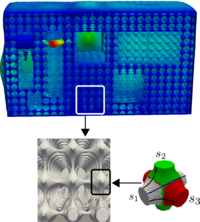
This project aims to advance techniques for lattice optimization in the context of additive manufacturing using titanium alloy (Ti-6Al-4V). We study the full workflow from selection of parametrized base cells for stiffness optimization, the optimization algorithm, the interpretation of optimized results as a macroscopic lattice design including predefined solid and void non-design regions, and the generation of a ready-to-print surface description of the lattice structure. For the field of structural optimization, the SGP (Sequential Global Programming) algorithm is advanced allowing the distinct choice between solid, void and lattice during the optimization process.

DFG Priority Programme 1679
Dynamic simulation of interconnected solids processes: modelling, simulation and optimization of process chains
SPP 1679: DynSim-FP
PI: Prof. Dr. G. Leugering, Coordinator: Prof. Dr. Stefan Heinrich (Hamburg)
Optimization of iron oxide pigments (2012–2017)
The dependency of the optical properties of a pigment film and the shape or shape distribution of the pigment is studied within this project. Further, this dependency is used to identify regions in parameterized shape space which will lead to better color values of the pigment.
Prof. Dr. Günter Leugering (Erlangen), Prof. Dr.-Ing. Wolfgang Peukert (Erlangen), Prof. Dr. Ulf Peschel (Erlangen), Prof. Dr. Robin N. Klupp Taylor (Erlangen), Dr. Lukas Pflug (Erlangen)
Industrial Partners
e.g. Adidas, Airbus, BASF, Lanxess, Procter & Gamble, Schaeffler, Siemens
Projects in CRIS
SFB/TRR 154 B06: Robust optimization of gas networks (B06)
(Third Party Funds Group – Sub project)Overall project: Mathematische Modellierung, Simulation und Optimierung am Beispiel von Gasnetzwerken
Project leader: ,
Term: 01.07.2022 - 30.06.2026
Acronym: SFB/TRR 154 B06
Funding source: Deutsche Forschungsgemeinschaft (DFG)
URL: https://www.trr154.fau.de/SFB 814 (T3): Process strategies for the production of thin-walled components during selective laser beam melting of plastics
(Third Party Funds Group – Sub project)Overall project: CRC 814 - Additive Manufacturing
Project leader: ,
Term: 01.01.2021 - 31.12.2023
Acronym: SFB 814 (T3)
Funding source: DFG / Sonderforschungsbereich (SFB)
URL: https://www.crc814.research.fau.eu/projekte/t-transferprojekte/transferproject-t3/The aim of theproject is the systematic investigation of the process-geometry-interaction ofthin-walled components for the production of locally adapted properties as wellas the modeling of this effect in finite element simulations and structuraloptimization. In experimental tests, the main influencing factors areidentified and mapped in relation to the building position in the process. Newexposure technologies and strategies are used to manipulate the melting pooland homogenize component properties. The findings are incorporated into a wallthickness dependent material model for structural optimization, which isinvestigated in the project. The participating industrial partners willvalidate the results over the course of the project. The experimental findingsand the wall thickness dependent material model will be used to develop amethodology for the product development of thin-walled structures. In thefuture, the product development process can be accelerated, and the economicefficiency increased. Based on these findings, new application areas for theselective laser beam melting of plastics can be opened up in the future.
SFB 1411 - INF: Information management and computational science support
(Third Party Funds Group – Sub project)Overall project: SFB 1411: Design of particulate products
Project leader: ,
Term: 01.01.2020 - 31.12.2023
Acronym: SFB 1411 - INF
Funding source: DFG / Sonderforschungsbereich (SFB)SFB 1411 - D05: Topology, material and shape optimisation for particle ensembles
(Third Party Funds Group – Sub project)Overall project: SFB 1411: Design of particulate products
Project leader:
Term: 01.01.2020 - 31.12.2023
Acronym: SFB 1411 - D05
Funding source: DFG / Sonderforschungsbereich (SFB)The objective is the development of a mathematical framework which allows to conclude from desired optical properties to a corresponding optimised configuration of single particles as well as particle assemblies. A structural optimisation approach based on discrete dipole approximations is explored to allow for a design space with sufficiently high resolution and enabling the prediction of structure-property relations of individual particles. For particle assemblies a structural optimisation method based on a generalised hybrid finite element approach is established. Finally, dispersity and angle independency are taken into account by a new stochastic optimisation method.GRK2423 - P11: Teilprojekt P11 - Fracture Control by Material Optimization
(Third Party Funds Group – Sub project)Overall project: Skalenübergreifende Bruchvorgänge: Integration von Mechanik, Materialwissenschaften, Mathematik, Chemie und Physik (FRASCAL)
Project leader: ,
Term: 02.01.2019 - 31.12.2027
Acronym: GRK2423 - P11
Funding source: DFG / Graduiertenkolleg (GRK)
URL: https://www.frascal.research.fau.eu/home/research/p-11-fracture-control-by-material-optimization/In previous works, the dependence of failure mechanisms in composite materials like debonding of the matrix-fibre interface or fibre breakage have been discussed. The underlying model was based on specific cohesive zone elements, whose macroscopic properties could be derived from DFT. It has been shown that the dissipated energy could be increased by appropriate choices of cohesive parameters of the interface as well as aspects of the fibre. However due to the numerical complexity of applied simulation methods the crack path had to be fixed a priori. Only recently models allow computing the full crack properties at macroscopic scale in a quasi-static scenario by the solution of a single nonlinear variational inequality for a given set of material parameters and thus model based optimization of the fracture properties can be approached.
The goal of the project is to develop an optimization method, in the framework of which crack properties (e.g. the crack path) can be optimized in a mathematically rigorous way. Thereby material properties of matrix, fibre and interfaces should serve as optimization variables.
GRK2423 - P10: Teilprojekt P10 - Configurational Fracture/Surface Mechanics
(Third Party Funds Group – Sub project)Overall project: Fracture across Scales: Integrating Mechanics, Materials Science, Mathematics, Chemistry, and Physics (FRASCAL)
Project leader: ,
Term: 02.01.2019 - 31.12.2027
Acronym: GRK2423 - P10
Funding source: DFG / Graduiertenkolleg (GRK)
URL: https://www.frascal.research.fau.eu/home/research/p-10-configurational-fracture-surface-mechanics/In a continuum the tendency of pre-existing cracks to propagate through the ambient material is assessed based on the established concept of configurational forces. In practise crack propagation is however prominently affected by the presence and properties of either surfaces and/or interfaces in the material. Here materials exposed to various surface treatments are mentioned, whereby effects of surface tension and crack extension can compete. Likewise, surface tension in inclusion-matrix interfaces can often not be neglected. In a continuum setting the energetics of surfaces/interfaces is captured by separate thermodynamic potentials. Surface potentials in general result in noticeable additions to configurational mechanics. This is particularly true in the realm of fracture mechanics, however its comprehensive theoretical/computational analysis is still lacking.
The project aims in a systematic account of the pertinent surface/interface thermodynamics within the framework of geometrically nonlinear configurational fracture mechanics. The focus is especially on a finite element treatment, i.e. the Material Force Method [6]. The computational consideration of thermodynamic potentials, such as the free energy, that are distributed within surfaces/interfaces is at the same time scientifically challenging and technologically relevant when cracks and their kinetics are studied.
Robustification of Physics Parameters in Gas Networks (B06) (2018 - 2022)
(Third Party Funds Group – Sub project)Overall project: TRR 154: Mathematische Modellierung, Simulation und Optimierung am Beispiel von Gasnetzwerken
Project leader: ,
Term: 01.07.2018 - 30.06.2022
Funding source: DFG / Sonderforschungsbereich / Transregio (SFB / TRR)The goal of this research project is to study uncertain optimization problems using robust optimization methods. Focusing on transport networks, we aim at the development of tractable robust counterparts for uncertain optimization problems and an analysis of the problem structure. For the arising adjustable robust optimization tasks, good relaxations as well as effective branch-and-bound implementations shall be developed.
Robustification of Physics Parameters in Gas Networks (B06) (2014 - 2018)
(Third Party Funds Group – Sub project)Overall project: TRR 154: Mathematical Modelling, Simulation and Optimisation Using the Example of Gas Networks
Project leader: ,
Term: since 01.07.2014
Funding source: DFG / Sonderforschungsbereich / Transregio (SFB / TRR)
URL: https://en.www.math.fau.de/edom/projects-edom/energy/robustification-of-physical-parameters-in-gas-networks/The goal of this research project is to study uncertain optimization problems using robust optimization methods. Focusing on transport networks, we aim at the development of tractable robust counterparts for uncertain optimization problems and an analysis of the problem structure. For the arising adjustable robust optimization tasks, good relaxations as well as effective branch-and-bound implementations shall be developed.SFB 814 (C2): Robust Structure-Process-Optimization (C2)
(Third Party Funds Group – Sub project)Overall project: CRC 814 - Additive Manufacturing
Project leader:
Term: 01.07.2011 - 30.06.2023
Acronym: SFB 814 (C2)
Funding source: DFG / Sonderforschungsbereich (SFB)Sub-project C2 is concerned with material and topologyoptimization in the context of additive manufacturing (AM). Based on a newflexible multi-material optimization concept developed in the second phase,which allows to consider process dependent materials, the focus will be now onmultifunctional components. The multifunctionality will be enabled by theintegration of graded lattice structures, which are known to exhibit astabilizing effect w.r.t. buckling and can provide exceptional dynamicproperties, such as the suppression of undesired vibrations. By this, thedesign freedom of AM shall be ultimately exploited.
- , , :
Nonlocal conservation laws with p-norm, the singular limit problem and applications to traffic flow
In: Journal of Mathematical Analysis and Applications 565 (2027), Article No.: 130960
ISSN: 0022-247X
DOI: 10.1016/j.jmaa.2026.130960
BibTeX: Download
- , , :
Branch-and-cut for mixed-integer robust chance-constrained optimization with discrete distributions
In: European Journal of Operational Research (2026)
ISSN: 0377-2217
DOI: 10.1016/j.ejor.2026.08.027
BibTeX: Download - , , :
Branch-and-cut for mixed-integer robust chance-constrained optimization with discrete distributions
(2026)
URL: https://opus4.kobv.de/opus4-trr154/609
BibTeX: Download - , , :
Robust chance-constrained optimization with discrete distributions
In: Journal of Global Optimization (2026)
ISSN: 0925-5001
DOI: 10.1007/s10898-026-01608-7
BibTeX: Download - , , :
Algorithms for robust chance-constrained optimization with mixture ambiguity
In: Optimization and Engineering (2026)
ISSN: 1389-4420
DOI: 10.1007/s11081-026-10093-6
BibTeX: Download - , , , , , :
Mechanism enabled population balance modeling of gold nanoparticle formation
In: Chemical Engineering Journal 540 (2026), Article No.: 177063
ISSN: 1385-8947
DOI: 10.1016/j.cej.2026.177063
BibTeX: Download - , , :
ASYMPTOTICS OF A HETEROGENEOUS CANHAM–HELFRICH FLEXOELECTRIC BIOMEMBRANE
In: Mathematics and Mechanics of Complex Systems 14 (2026), p. 257-283
ISSN: 2326-7186
DOI: 10.2140/memocs.2026.14.257
BibTeX: Download - , , , , :
Bridging experiments and simulations towards a mechanistic understanding of gold patchy nanoparticle formation
In: Chemical Engineering Journal Advances (2026)
ISSN: 2666-8211
DOI: 10.1016/j.ceja.2026.101214
URL: https://www.sciencedirect.com/science/article/pii/S2666821126001821
BibTeX: Download - , , :
A 140 line MATLAB code for topology optimization problems with probabilistic parameters
In: Structural and Multidisciplinary Optimization 69 (2026), Article No.: 7
ISSN: 1615-147X
DOI: 10.1007/s00158-025-04167-9
BibTeX: Download
- , , , :
A Gradient-Based Method for Joint Chance-Constrained Optimization with Continuous Distributions
In: Optimization Methods & Software (2025)
ISSN: 1055-6788
DOI: 10.1080/10556788.2025.2581585
BibTeX: Download - , , , , , :
Predictive Design to Determine Optimal Absorber Placement in Colloidal Photonic Crystals
In: Advanced Optical Materials (2025), Article No.: 2403279
ISSN: 2195-1071
DOI: 10.1002/adom.202403279
BibTeX: Download - , , , , , , , :
Predictive design of plasmonic color
In: Journal of Colloid and Interface Science (2025), p. 137408
ISSN: 0021-9797
DOI: 10.1016/j.jcis.2025.137408
BibTeX: Download - , :
Automatic projection parameter increase for three-field density-based topology optimization
In: Structural and Multidisciplinary Optimization 68 (2025), Article No.: 33
ISSN: 1615-147X
DOI: 10.1007/s00158-025-03968-2
BibTeX: Download - , , :
On the numerical solution of Lasserre relaxations of unconstrained binary quadratic optimization problem
In: Journal of Global Optimization (2025)
ISSN: 0925-5001
DOI: 10.1007/s10898-025-01523-3
BibTeX: Download - , , , :
Robust Structure-Process-Optimization
In: Dietmar Drummer, Michael Schmidt (ed.): Progress in Powder Based Additive Manufacturing, Springer Nature, 2025, p. 243-262 (Springer Tracts in Additive Manufacturing, Vol.Part F386)
DOI: 10.1007/978-3-031-78350-0_12
BibTeX: Download - , , :
A Stochastic Method of Moving Asymptotes for Topology Optimization Under Uncertainty
In: International Journal for Numerical Methods in Engineering 126 (2025), Article No.: e70109
ISSN: 0029-5981
DOI: 10.1002/nme.70109
BibTeX: Download - , , , , , , , :
Modeling and Simulation of Standing Wave Configurations for Outflow Improvement and Minimizing Undesired Recirculation
In: Applied Sciences 15 (2025), Article No.: 3127
ISSN: 2076-3417
DOI: 10.3390/app15063127
BibTeX: Download - , , , , , , , , , :
Silver incorporation into gold patchy nanoparticles: Influence on the tunability and long-term stability of plasmonic properties
In: Journal of Physical Chemistry C (2025)
ISSN: 1932-7447
DOI: 10.1021/acs.jpcc.5c02380
BibTeX: Download - , , , :
A nonlocal approach to graded surface modeling in topology optimization
In: Structural and Multidisciplinary Optimization 68 (2025), Article No.: 83
ISSN: 1615-147X
DOI: 10.1007/s00158-025-04024-9
BibTeX: Download
- , , , , , , :
Optimizing Color Saturation in Colloidal Photonic Crystals by Control of Absorber Amount and Distribution
In: Advanced Materials Interfaces (2024), Article No.: 2300986
ISSN: 2196-7350
DOI: 10.1002/admi.202300986
BibTeX: Download - , , :
Efficient and Accurate Separable Models for Discretized Material Optimization: A Continuous Perspective Based on Topological Derivatives
In: Journal of Geometric Analysis 34 (2024), Article No.: 206
ISSN: 1050-6926
DOI: 10.1007/s12220-024-01663-0
BibTeX: Download - , , , :
The continuous stochastic gradient method: part II–application and numerics
In: Computational Optimization and Applications 87 (2024), p. 977-1008
ISSN: 0926-6003
DOI: 10.1007/s10589-023-00540-w
BibTeX: Download - , , , , , , :
Quality Control in Particle Precipitation via Robust Optimization
In: Computers & Chemical Engineering (2024)
ISSN: 0098-1354
DOI: 10.1016/j.compchemeng.2024.108619
BibTeX: Download - , , , :
Topology optimization of broadband acoustic transition section: a comparison between deterministic and stochastic approaches
In: Structural and Multidisciplinary Optimization 67 (2024), Article No.: 67
ISSN: 1615-147X
DOI: 10.1007/s00158-024-03784-0
BibTeX: Download - , , , , , , , , , , :
Continuous Flow Synthesis and Simulation-Supported Investigation of Tunable Plasmonic Gold Patchy Nanoparticles
In: Nanoscale (2024)
ISSN: 2040-3364
DOI: 10.1039/D4NR02516D
URL: https://pubs.rsc.org/en/content/articlelanding/2024/nr/d4nr02516d
BibTeX: Download - :
The Continuous Stochastic Gradient Method (Dissertation, 2024)
DOI: 10.25593/open-fau-394
BibTeX: Download - , :
Stabilized SQP Methods in Hilbert Spaces
In: Numerical Functional Analysis and Optimization (2024), p. 1-33
ISSN: 0163-0563
DOI: 10.1080/01630563.2024.2384861
BibTeX: Download - :
Optimization and generation of cellular structures for additive manufacturing with mechanical and thermomechanical applications (Thesis, 2024)
DOI: 10.25593/open-fau-916
BibTeX: Download
- , , , , , , , , , , :
Determination of 2D Particle Size Distributions in Plasmonic Nanoparticle Colloids via Analytical Ultracentrifugation: Application to Gold Bipyramids.
In: ACS nano (2023)
ISSN: 1936-0851
DOI: 10.1021/acsnano.2c12257
BibTeX: Download - , , , :
Efficient spline design via feature-mapping for continuous fiber-reinforced structures
In: Structural and Multidisciplinary Optimization 66 (2023)
ISSN: 1615-147X
DOI: 10.1007/s00158-023-03534-8
BibTeX: Download - , , , :
Correction to: The continuous stochastic gradient method: part II–application and numerics (Computational Optimization and Applications, (2023), 10.1007/s10589-023-00540-w)
In: Computational Optimization and Applications (2023)
ISSN: 0926-6003
DOI: 10.1007/s10589-023-00544-6
BibTeX: Download - , , , :
The continuous stochastic gradient method: part I–convergence theory
In: Computational Optimization and Applications (2023)
ISSN: 0926-6003
DOI: 10.1007/s10589-023-00542-8
BibTeX: Download - , , :
Loraine–an interior-point solver for low-rank semidefinite programming
In: Optimization Methods & Software (2023)
ISSN: 1055-6788
DOI: 10.1080/10556788.2023.2250522
BibTeX: Download - , , , , , :
Buckling optimization of additively manufactured cellular structures using numerical homogenization based on beam models
In: Archive of Applied Mechanics (2023)
ISSN: 0939-1533
DOI: 10.1007/s00419-023-02503-3
BibTeX: Download - , , :
Two-scale optimization of graded lattice structures respecting buckling on micro- and macroscale
In: Structural and Multidisciplinary Optimization 66 (2023), Article No.: 163
ISSN: 1615-147X
DOI: 10.1007/s00158-023-03619-4
BibTeX: Download - , , :
Two-scale optimization of graded lattice structures respecting buckling on micro- and macroscale
In: Structural and Multidisciplinary Optimization 66 (2023), Article No.: 163
ISSN: 1615-147X
DOI: 10.1007/s00158-023-03619-4
BibTeX: Download - , :
Discontinuous nonlocal conservation laws and related discontinuous ODEs – Existence, Uniqueness, Stability and Regularity
In: Comptes Rendus Mathematique 361 (2023), p. 1723-1760
ISSN: 1631-073X
DOI: 10.5802/crmath.490
BibTeX: Download - , , , , , , , , , , :
Additive manufacturing of cellular structures: Multiscale simulation and optimization
In: Journal of Manufacturing Processes 95 (2023), p. 275-290
ISSN: 1526-6125
DOI: 10.1016/j.jmapro.2023.03.071
BibTeX: Download - , , , :
Multi-material design optimization of optical properties of particulate products by discrete dipole approximation and sequential global programming
In: Structural and Multidisciplinary Optimization 66 (2023), Article No.: 5
ISSN: 1615-147X
DOI: 10.1007/s00158-022-03376-w
BibTeX: Download - , , , , , :
Using OpenBIS as Virtual Research Environment: An ELN-LIMS Open-Source Database Tool as a Framework within the CRC 1411 Design of Particulate Products
In: Data Science Journal 22 (2023), Article No.: 44
ISSN: 1683-1470
DOI: 10.5334/dsj-2023-044
BibTeX: Download - , , , :
On optimization of heterogeneous materials for enhanced resistance to bulk fracture
In: Forces in Mechanics 12 (2023), Article No.: 100200
ISSN: 2666-3597
DOI: 10.1016/j.finmec.2023.100200
BibTeX: Download - , , , , :
Targeted color design of silver-gold alloy nanoparticles
In: Nanoscale Advances (2023)
ISSN: 2516-0230
DOI: 10.1039/d3na00856h
BibTeX: Download - , , :
Optimizing Color of Particulate Products
In: Proceedings in Applied Mathematics and Mechanics 22 (2023), Article No.: e202200047
ISSN: 1617-7061
DOI: 10.1002/pamm.202200047
BibTeX: Download - , , , :
A sequential global programming approach for two-scale optimization of homogenized multiphysics problems with application to Biot porous media
In: Structural and Multidisciplinary Optimization 66 (2023), Article No.: 211
ISSN: 1615-147X
DOI: 10.1007/s00158-023-03659-w
BibTeX: Download
- , , , , :
Multi-objective free-form shape optimization of a synchronous reluctance machine
In: Compel-The International Journal For Computation and Mathematics in Electrical and Electronic Engineering (2022)
ISSN: 0332-1649
DOI: 10.1108/COMPEL-02-2021-0063
BibTeX: Download - , , , , , :
Thin-Walled Part Properties in PBF-LB/P — Experimental Understanding and Nonlocal Material Model
SFF 2022 (Austin, Texas, 25.07.2022 - 27.07.2022)
DOI: 10.26153/tsw/44659
BibTeX: Download - , , :
Adaptive bundle methods for nonlinear robust optimization
In: Informs Journal on Computing 34 (2022), p. 2106 - 2124
ISSN: 1091-9856
DOI: 10.1287/ijoc.2021.1122
BibTeX: Download
(Techreport) - , , , , , , , , , , :
Determination of the yield, mass and structure of silver patches on colloidal silica using multiwavelength analytical ultracentrifugation
In: Journal of Colloid and Interface Science 607 (2022), p. 698-710
ISSN: 0021-9797
DOI: 10.1016/j.jcis.2021.08.161
URL: https://www.researchgate.net/publication/354270035_Determination_of_the_yield_mass_and_structure_of_silver_patches_on_colloidal_silica_using_multiwavelength_analytical_ultracentrifugation
BibTeX: Download - , , :
ANALYSIS OF EQUILIBRIUM DISPERSIVE MODEL OF LIQUID CHROMATOGRAPHY CONSIDERING A QUADRATIC-TYPE ADSORPTION ISOTHERM
In: Thermal Science 26 (2022), p. 2069-2080
ISSN: 0354-9836
DOI: 10.2298/TSCI201229179U
BibTeX: Download - , , , :
Robust design optimization for enhancing delamination resistance of composites
In: International Journal for Numerical Methods in Engineering (2022)
ISSN: 0029-5981
DOI: 10.1002/nme.7168
BibTeX: Download
- , , , , , , :
Robust Optimization in Nanoparticle Technology: A Proof of Principle by Quantum Dot Growth in a Residence Time Reactor
In: Computers & Chemical Engineering (2021)
ISSN: 0098-1354
DOI: 10.1016/j.compchemeng.2021.107618
URL: http://www.optimization-online.org/DB_HTML/2021/02/8262.html
BibTeX: Download - , , , :
A pseudo density topology optimization approach in nonlinear electromagnetism applied to a 3D actuator
In: International Journal of Applied Electromagnetics and Mechanics 65 (2021), p. 545-559
ISSN: 1383-5416
DOI: 10.3233/JAE-201501
BibTeX: Download - , , :
Material optimization to enhance delamination resistance of composite structures using viscous regularization
In: Computer Methods in Applied Mechanics and Engineering (2021)
ISSN: 0045-7825
DOI: 10.1016/j.cma.2021.113881
URL: https://www.sciencedirect.com/science/article/pii/S0045782521002188
BibTeX: Download - , :
Material optimization for controlling interfacial damage in composite structures
In: Proceedings in Applied Mathematics and Mechanics 20 (2021)
ISSN: 1617-7061
DOI: 10.1002/pamm.202000344
BibTeX: Download - , , :
Two-Scale Optimization and Generation of Anisotropic Cellular Designs in the Context of Additive Manufacturing
In: Computer-Aided Design 140 (2021), Article No.: 103073
ISSN: 0010-4485
DOI: 10.1016/j.cad.2021.103073
BibTeX: Download
- , , , , , , , , , , :
Joint model of probabilistic/robust (probust) constraints with application to gas network optimization
In: Vietnam Journal of Mathematics (2020)
ISSN: 0866-7179
DOI: 10.1007/s10013-020-00434-y
URL: https://link.springer.com/article/10.1007/s10013-020-00434-y
BibTeX: Download
(Techreport) - , :
Topology optimization with worst-case handling of material uncertainties
In: Structural and Multidisciplinary Optimization 61 (2020), p. 1377-1397
ISSN: 1615-147X
DOI: 10.1007/s00158-019-02411-7
BibTeX: Download - , , , :
CSG: A new stochastic gradient method for the efficient solution of structural optimization problems with infinitely many states
In: Structural and Multidisciplinary Optimization (2020)
ISSN: 1615-147X
DOI: 10.1007/s00158-020-02571-x
BibTeX: Download - , , , , :
eMoM: Exact method of moments—Nucleation and size dependent growth of nanoparticles
In: Computers & Chemical Engineering 136 (2020), Article No.: 106775
ISSN: 0098-1354
DOI: 10.1016/j.compchemeng.2020.106775
BibTeX: Download - , :
On the efficient optimization of optical properties of particulate monolayers by a hybrid finite element approach
In: Structural and Multidisciplinary Optimization (2020)
ISSN: 1615-147X
DOI: 10.1007/s00158-020-02754-6
BibTeX: Download - , , , , :
Modeling, Simulation and Optimization of Process Chains
In: Heinrich, Stefan (ed.): Dynamic Flowsheet Simulation of Solids Processes, Springer International Publishing, 2020, p. 549-578
ISBN: 978-3-030-45167-7
DOI: 10.1007/978-3-030-45168-4
BibTeX: Download - , , , :
GRADIENT-BASED TWO-SCALE TOPOLOGY OPTIMIZATION WITH B-SPLINES ON SPARSE GRIDS
In: SIAM Journal on Scientific Computing 42 (2020), p. B1092-B1114
ISSN: 1064-8275
DOI: 10.1137/19M128822X
BibTeX: Download
- , , :
Decomposable robust two-stage optimization: An application to gas network operations under uncertainty
In: Networks (2019)
ISSN: 0028-3045
DOI: 10.1002/net.21871
URL: https://onlinelibrary.wiley.com/doi/abs/10.1002/net.21871
BibTeX: Download - , , , :
Multidimensional Particle Size Distributions and Their Application to Nonspherical Particle Systems in Two Dimensions
In: Particle & Particle Systems Characterization (2019), Article No.: 1800554
ISSN: 0934-0866
DOI: 10.1002/ppsc.201800554
BibTeX: Download - , , :
How to Estimate Material Parameters for Multiphase, Multicomponent Precipitation Modeling
In: Crystal Growth and Design 19 (2019), p. 2785-2793
ISSN: 1528-7483
DOI: 10.1021/acs.cgd.9b00027
BibTeX: Download - , , , :
Optimization of the porous material described by the Biot model
In: International Journal of Solids and Structures 156-157 (2019), p. 216-233
ISSN: 0020-7683
DOI: 10.1016/j.ijsolstr.2018.08.016
BibTeX: Download - , , , , , , , , :
Towards a lifecycle oriented design of infrastructure by mathematical optimization
In: Optimization and Engineering 20 (2019), p. 215-249
ISSN: 1389-4420
DOI: 10.1007/s11081-018-9406-5
BibTeX: Download - , , , , :
SIMULATION AND STRUCTURAL OPTIMIZATION OF 3D TIMOSHENKO BEAM NETWORKS BASED ON FULLY ANALYTIC NETWORK SOLUTIONS
In: Esaim-Mathematical Modelling and Numerical Analysis-Modelisation Mathematique Et Analyse Numerique 52 (2019), p. 2409-2431
ISSN: 0764-583X
DOI: 10.1051/m2an/2018065
BibTeX: Download - , :
On approximation of local conservation laws by nonlocal conservation laws
In: Journal of Mathematical Analysis and Applications 475 (2019), p. 1927-1955
ISSN: 0022-247X
DOI: 10.1016/j.jmaa.2019.03.063
BibTeX: Download - , , , , , , :
Influence of spatial camera resolution in highspeed videoendoscopy on laryngeal parameters
In: PLoS ONE 14 (2019), Article No.: e0215168
ISSN: 1932-6203
DOI: 10.1371/journal.pone.0215168
BibTeX: Download - , , , , :
Topology optimization of unsaturated flows in multi-material porous media: Application to a simple diaper model
In: Communications in Nonlinear Science and Numerical Simulation 78 (2019), Article No.: 104871
ISSN: 1007-5704
DOI: 10.1016/j.cnsns.2019.104871
BibTeX: Download
- , , , :
Deciding Robust Feasibility and Infeasibility Using a Set Containment Approach: An Application to Stationary Passive Gas Network Operations
In: SIAM Journal on Optimization 28 (2018), p. 2489-2517
ISSN: 1052-6234
DOI: 10.1137/17M112470X
BibTeX: Download - , , , , , , , :
Hierarchical Design of Metal Micro/Nanohole Array Films Optimizes Transparency and Haze Factor
In: Advanced Functional Materials (2018)
ISSN: 1616-301X
DOI: 10.1002/adfm.201706965
BibTeX: Download - , , , , , , , , , :
Topology Optimization in Additive Manufacturing Considering the Grain Structure of Inconel 718 using Numerical Homogenization
iCAT 2018 (Maribor, 10.10.2018 - 11.10.2018)
In: Proceedings of 7th International Conference on Additive Technologies 2018
BibTeX: Download - , , :
Existence, uniqueness and regularity of multi-dimensional nonlocal balance laws with damping
In: Journal of Mathematical Analysis and Applications 466 (2018), p. 18-55
ISSN: 0022-247X
DOI: 10.1016/j.jmaa.2018.05.013
BibTeX: Download - , , , , , , , :
Anisometric engineering of particle interfaces: Multidimensional characterization and gram‐scale production
ProcessNet‐Jahrestagung und 33. DECHEMA‐Jahrestagung der Biotechnologen 2018 (Aachen, 11.09.2018 - 13.09.2018)
In: Chemie Ingenieur Technik (Special Issue: ProcessNet‐Jahrestagung und 33. DECHEMA‐Jahrestagung der Biotechnologen 2018), Weinheim: 2018
DOI: 10.1002/cite.201855147
URL: https://onlinelibrary.wiley.com/doi/abs/10.1002/cite.201855147?af=R
BibTeX: Download - , :
Multi-Material Optimization of Nanoparticles by Discrete Dipole Approximation and Sequential Global Programming
In: Thomas Wriedt, Yuri Eremin Eds. (ed.): Proceedings of the Bremen Workshopon Light Scattering: 2018, 2018
BibTeX: Download - , , , , , :
Dependencies and Ill-designed Parameters Within High-speed Videoendoscopy and Acoustic Signal Analysis
In: Journal of Voice (2018)
ISSN: 0892-1997
DOI: 10.1016/j.jvoice.2018.04.011
BibTeX: Download - , , , , :
Particulate Coatings with Optimized Haze Properties
In: Advanced Functional Materials 5 (2018), Article No.: 1806025
ISSN: 1616-301X
DOI: 10.1002/adfm.201806025
URL: https://onlinelibrary.wiley.com/doi/full/10.1002/adfm.201806025
BibTeX: Download - , , :
Material optimization in transverse electromagnetic scattering applications
In: SIAM Journal on Scientific Computing 40 (2018), p. B85-B109
ISSN: 1064-8275
DOI: 10.1137/17M1127569
BibTeX: Download - , :
A combined parametric shape optimization and ersatz material approach
In: Structural and Multidisciplinary Optimization 57 (2018), p. 1297-1315
ISSN: 1615-147X
DOI: 10.1007/s00158-017-1812-3
BibTeX: Download - , , , , , :
Determination of the two-dimensional distributions of gold nanorods by multiwavelength analytical ultracentrifugation
In: Nature Communications 9 (2018), Article No.: 4898
ISSN: 2041-1723
DOI: 10.1038/s41467-018-07366-9
BibTeX: Download
- , :
Existence, uniqueness and regularity results on nonlocal balance laws
In: Journal of Differential Equations 263 (2017), p. 4023-4069
ISSN: 0022-0396
DOI: 10.1016/j.jde.2017.05.015
BibTeX: Download - , , , , :
Heterogeneous nucleation and surface conformal growth of silver nanocoatings on colloidal silica in a continuous flow static T-mixer
In: Chemical Engineering Journal 308 (2017), p. 89-100
ISSN: 1385-8947
DOI: 10.1016/j.cej.2016.09.048
BibTeX: Download - , , , :
Model-Based Optimization of Short Stroke Control in Roughing Mills
In: Steel Research International 88 (2017), Article No.: 1700220
ISSN: 1611-3683
DOI: 10.1002/srin.201700220
BibTeX: Download - , , :
Model-based control of dynamic frictional contact problems using the example of hot rolling
In: Computer Methods in Applied Mechanics and Engineering 319 (2017), p. 442-471
ISSN: 0045-7825
DOI: 10.1016/j.cma.2017.03.006
BibTeX: Download - , , , :
Design and Additive Manufacturing of 3D Phononic Band Gap Structures Based on Gradient Based Optimization
In: Materials 10 (2017)
ISSN: 1996-1944
DOI: 10.3390/ma10101125
BibTeX: Download
- , :
Robust optimal component design unter consideration of local material defects
In: Proceedings of the 6th international conference on additive technologies (iCAT 2016), Ljubljana: Interesansa - zavod, 2016
ISBN: 978-961-285-537-6
BibTeX: Download - , :
Simultaneous parametric material and topology optimization with constrained material grading
In: Structural and Multidisciplinary Optimization (2016), p. 1-14
ISSN: 1615-147X
DOI: 10.1007/s00158-016-1457-7
BibTeX: Download - , , , , , :
Geometry: The leading parameter for the Poisson's ratio of bending-dominated cellular solids
In: International Journal of Solids and Structures 100 (2016), p. 1-10
ISSN: 0020-7683
DOI: 10.1016/j.ijsolstr.2016.06.027
BibTeX: Download
- , , , , , :
From in situ characterization to process control of quantum dot systems
7th World Congress on Particle Technology, WCPT 2014 (Bejing, 19.05.2014 - 22.05.2014)
DOI: 10.1016/j.proeng.2015.01.129
BibTeX: Download - , , , :
On the efficient solution of a patch problem with multiple elliptic inclusions
In: Optimization and Engineering 16 (2015), p. 225-246
ISSN: 1389-4420
DOI: 10.1007/s11081-014-9262-x
BibTeX: Download - , , , :
Shape Optimization in Electromagnetic Applications
In: Aldo Pratelli, Günter Leugering (ed.): New Trends in Shape Optimization, Springer, 2015, p. 251-269 (International Series of Numerical Mathematics, Vol.166)
DOI: 10.1007/978-3-319-17563-8_11
BibTeX: Download
- , :
Simultaneous Material and Topology Optimization Based on Topological Derivatives
In: Christian Pötzsche, Clemens Heuberger, Barbara Kaltenbacher, Franz Rendl (ed.): System Modeling and Optimization, Berlin Heidelberg: Springer, 2014, p. 118-127 (IFIP Advances in Information and Communication Technology, Vol.443)
DOI: 10.1007/978-3-662-45504-3_11
BibTeX: Download - , :
Simultaneous optimization of topology and build orientation in layered manufacturing
In: 5th International Conference on Additive Technologies (iCAT), 2014
BibTeX: Download
- , , , :
A cohesive crack propagation model: Mathematical theory and numerical solution
In: Communications on Pure and Applied Analysis 12 (2013), p. 1705-1729
ISSN: 1534-0392
DOI: 10.3934/cpaa.2013.12.1705
BibTeX: Download - , , , , , :
Material and shape optimization for multi-layered vocal fold models using transient loadings
In: Journal of the Acoustical Society of America 134 (2013), p. 1261-1270
ISSN: 0001-4966
DOI: 10.1121/1.4812253
BibTeX: Download - , , :
Topology optimization of a cantilevered piezoelectric energy harvester using stress norm constraints
In: Structural and Multidisciplinary Optimization 48 (2013), p. 173-185
ISSN: 1615-147X
DOI: 10.1007/s00158-013-0889-6
BibTeX: Download
- , , , :
Numerische Simulation pulver- und strahlbasierter additiver Fertigungsprozesse
Industriekolloqium des Sonderforschungsbereichs 814 – Additive Fertigung
BibTeX: Download - , :
Solving stress constrained problems in topology and material optimization
In: Structural and Multidisciplinary Optimization 46 (2012), p. 1-15
ISSN: 1615-147X
DOI: 10.1007/s00158-012-0762-z
BibTeX: Download - , , , :
The Eshelby Theorem and Application to the optimization of an Elastic Patch
In: SIAM Journal on Applied Mathematics 72 (2012), p. 512-534
ISSN: 0036-1399
DOI: 10.1137/110823110
BibTeX: Download - , , , :
Optimal Design of Brittle Composite Materials: a Nonsmooth Approach
In: Journal of Optimization Theory and Applications 155 (2012), p. 962-985
ISSN: 0022-3239
DOI: 10.1007/s10957-012-0094-6
BibTeX: Download - , , :
Efficient two-scale optimization of manufacturable graded structures
In: SIAM Journal on Scientific Computing 34 (2012), p. B711-B733
ISSN: 1064-8275
DOI: 10.1137/110850335
BibTeX: Download - , , :
Slope constrained material design
In: Structural and Multidisciplinary Optimization 46 (2012), p. 813-827
ISSN: 1615-147X
DOI: 10.1007/s00158-012-0795-3
BibTeX: Download - , , , , , :
Mechanical characterisation of a periodic auxetic structure produced by SEBM
In: physica status solidi (b) 249 (2012), p. 1347-1352
ISSN: 0370-1972
DOI: 10.1002/pssb.201084211
BibTeX: Download - , :
Parametric Shape Optimization Revisited
In: Michael Hintermüller, Günter Leugering. Jan Sokolowski (ed.): Mini-Workshop: Geometries, Shapes and Topologies in PDE-based Applications, Oberwolfach: European Mathematical Society Publishing House, 2012, p. 3400-3403 (Oberwolfach Reports, Vol.57)
DOI: 10.4171/OWR/2012/57
BibTeX: Download
- , , , , , , , :
Devices and Methods on Analysis of Biomechanical Properties of Laryngeal Tissue and Substitute Materials
In: Current Bioinformatics 6 (2011), p. 344-361
ISSN: 1574-8936
BibTeX: Download - , :
PENNON - software for linear and nonlinear matrix inequalities
In: Miguel F. Anjos, Jean B. Lasserre (ed.): Handbook on Semidefinite, Conic and Polynomial Optimization, New York: Springer, 2011, p. 755 ff.
BibTeX: Download - , , , , , , , , :
Erratum: Finding auxetic frameworks in periodic tessellations
In: Advanced Materials 23 (2011), p. 2669-2674
ISSN: 0935-9648
DOI: 10.1002/adma.201190118
BibTeX: Download - , , , , , , , , :
Finding Auxetic Frameworks in Periodic Tessellations
In: Advanced Materials 23 (2011), p. 2669-2674
ISSN: 0935-9648
DOI: 10.1002/adma.201100268
BibTeX: Download - , , , , :
Material parameter computation for multi-layered vocal fold models
In: Journal of the Acoustical Society of America 129 (2011), p. 2168-2180
ISSN: 0001-4966
DOI: 10.1121/1.3543988
BibTeX: Download - , , , , , , :
Design of Auxetic Structures via Mathematical Optimization
In: Advanced Materials 23 (2011), p. 2650--2654
ISSN: 0935-9648
DOI: 10.1002/adma.201004090
BibTeX: Download - , , , :
Optimized transformation of the glottal motion into a mechanical model
In: Medical Engineering & Physics 33 (2011), p. 210-217
ISSN: 1350-4533
DOI: 10.1016/j.medengphy.2010.09.019
BibTeX: Download - , , , , , , :
Computation of physiological human vocal fold parameters by mathematical optimization of a biomechanical model.
In: Journal of the Acoustical Society of America 130 (2011), p. 948-964
ISSN: 0001-4966
DOI: 10.1121/1.3605551
BibTeX: Download
- , , , :
Multidisciplinary Free Material Optimization
In: SIAM Journal on Applied Mathematics 70 (2010), p. 2709
ISSN: 0036-1399
DOI: 10.1137/090774446
BibTeX: Download - , , , , :
Experimental flow study of modeled regular and irregular glottal closure types
In: Logopedics Phoniatrics Vocology 35 (2010), p. 45-50
ISSN: 1401-5439
DOI: 10.3109/14015431003667652
BibTeX: Download - , , :
Topology and Dynamic Networks: Optimization with Application in Future Technologies
In: Martin Grötschel, Klaus Lucas, Volker Mehrmann (ed.): Production Factor Mathematics, Berlin Heidelberg: Springer, 2010, p. 263-276
DOI: 10.1007/978-3-642-11248-5_14
BibTeX: Download - , :
PDE-constrained optimization for advanced materials
In: GAMM-Mitteilungen 33 (2010), p. 209-229
ISSN: 0936-7195
DOI: 10.1002/gamm.201010016
URL: http://onlinelibrary.wiley.com/doi/10.1002/gamm.201010016/epdf
BibTeX: Download - , , , , , , :
Simulation of fracture in heterogeneous elastic materials with cohesive zone models
In: International Journal of Fracture (2010)
ISSN: 0376-9429
DOI: 10.1007/s10704-010-9552-z
BibTeX: Download
- , , :
Free material optimization for plates and shells
23rd IFIP TC 7 Conference on System Modelling and Optimization (Cracow, 23.07.2007 - 27.07.2007)
In: Proceedings of the 23rd IFIP TC 7 Conference on System Modelling and Optimization 2009
BibTeX: Download - , , , , :
Visualization of the flow through modulated irregular glottal gaps
In: International Institute of Acoustics and Vibration (ed.): Proceedings of the 16th International Congress on Sound and Vibration 2009, 2009, p. 2764-2771
ISBN: 9781615677368
BibTeX: Download - , , :
Topologie und Dynamische Netzwerke: Anwendungen Der Optimierung MIT Zukunft
In: Martin Grötschel, Klaus Lucas, Volker Mehrmann (ed.): Produktionsfaktor Mathematik - Wie Mathematik Technik und Wirtschaft Bewegt, Berlin Heidelberg: Springer, 2009, p. 323-338
DOI: 10.1007/978-3-540-89435-3_14
BibTeX: Download - , , :
A New Non-linear Semidefinite Programming Algorithm with an Application to Multidisciplinary Free Material Optimization
In: Optimal control of coupled systems of partial differential equations, 2009, p. 275--295 (Internat. Ser. Numer. Math., Vol.158)
DOI: 10.1007/978-3-7643-8923-9_16
BibTeX: Download - , , :
A SEQUENTIAL CONVEX SEMIDEFINITE PROGRAMMING ALGORITHM WITH AN APPLICATION TO MULTIPLE-LOAD FREE MATERIAL OPTIMIZATION
In: SIAM Journal on Optimization 20 (2009), p. 130-155
ISSN: 1052-6234
DOI: 10.1137/070711281
BibTeX: Download - , , :
Free Material Optimization with Fundamental Eigenfrequency Constraints
In: SIAM Journal on Optimization 20 (2009), p. 524--547
ISSN: 1052-6234
DOI: 10.1137/080717122
BibTeX: Download
- , , , , :
Biomechanical modeling of laryngeal dynamics
2008 First International Symposium on Applied Sciences on Biomedical and Communication Technologies (Aalborg)
DOI: 10.1109/ISABEL.2008.4712600
BibTeX: Download - , :
Free Material Optimization: Towards the Stress constraints
In: K. Kunisch, G. Leugering, J. Sprekels, F. Tröltzsch (ed.): Optimal Control of Coupled Systems of PDE, Oberwolfach: European Mathematical Society Publishing House, 2008, p. 620-622 (Oberwolfach Reports, Vol.13)
DOI: 10.4171/OWR/2008/1
BibTeX: Download - , , :
Free material optimization: recent progress
In: Optimization 57 (2008), p. 79-100
ISSN: 0233-1934
DOI: 10.1080/02331930701778908
BibTeX: Download - , , :
A New Method for the Solution of Multi-Disciplinary Free Material Optimization Problems
In: Karl Kunisch, Günter Leugering, Jürgen Sprekels and Fredi Tröltzsch (ed.): Optimal Control of Coupled Systems of PDE, Oberwolfach: European Mathematical Society Publishing House, 2008, p. 647-649 (Oberwolfach Reports, Vol.13)
DOI: 10.4171/OWR/2008/13
BibTeX: Download - , , :
Topologie und dynamische Netzwerke: Anwendungen der Zukunft
In: M. Grötschel, K. Lucas, V. Mehrmann (ed.): Produktionsfaktor Mathematik, 2008, p. 323 -- 340 (acatech diskutiert)
BibTeX: Download
- , :
Free material optimization for stress constraints
In: Structural and Multidisciplinary Optimization 33 (2007), p. 323-335
ISSN: 1615-147X
DOI: 10.1007/s00158-007-0095-5
BibTeX: Download - , :
On the solution of large-scale SDP problems by the modified barrier method using iterative solvers
In: Mathematical Programming 109 (2007), p. 413-444
ISSN: 0025-5610
DOI: 10.1007/s10107-008-0250-9
BibTeX: Download - :
Quadratic programming and affine variational inequalities: a qualitative study by G. M. Lee, N. N. Tam and N. D. Yen
In: Mathematical Methods of Operations Research 65 (2007), p. 385-387
ISSN: 1432-2994
DOI: 10.1007/s00186-006-0108-y
BibTeX: Download
- , :
The Worst-Case Multiple Load FMO Problem Revisited
In: Martin Philip Bendsøe, Niels Olhoff, Ole Sigmund (ed.): IUTAM Symposium on Topological Design Optimization of Structures, Machines and Materials, Springer Netherlands, 2006, p. 403-411 (Solid Mechanics and Its Applications, Vol.137)
DOI: 10.1007/1-4020-4752-5_40
BibTeX: Download - :
On the solution of nonlinear semidefinite programs by augmented Lagrangian methods
Aachen: Shaker Verlag, 2006
(Berichte Aus Der Mathematik)
ISBN: 978-3832253332
BibTeX: Download
- , , , :
Solving polynomial static output feedback problems with PENBMI
In: Proceedings of the 44th IEEE Conference on Decision and Control, 2005, p. 7581 - 7586
DOI: 10.1109/CDC.2005.1583385
BibTeX: Download - , , , :
A nonlinear SDP algorithm for static output feedback problems in COMPLEIB
In: IFAC Proceedings Volumes (IFAC-PapersOnline) 38 (2005), p. 1055-1060
ISSN: 1474-6670
DOI: 10.3182/20050703-6-CZ-1902.00832
BibTeX: Download - , :
Recent progress in the NLP-SDP code PENNON
In: F. Jarre, C. Lemarechal, J. Zowe (ed.): Optimization and Applications, Oberwolfach: European Mathematical Society Publishing House, 2005, p. 101-104 (Oberwolfach Reports, Vol.2)
DOI: 10.4171/OWR/2005/2
BibTeX: Download
- , :
PENNON: A code for convex nonlinear and semidefinite programming
In: Optimization Methods & Software 18 (2003), p. 317-333
ISSN: 1055-6788
DOI: 10.1080/1055678031000098773
BibTeX: Download - , :
PENNON - A generalized augmented Lagrangian method for semidefinite programming
In: Gianni Di Pillo, Almerico Murli (ed.): High Performance Algorithms and Software for Nonlinear Optimization, 2003, p. 303-321 (Applied Optimization, Vol.82)
DOI: 10.1007/978-1-4613-0241-4_14
BibTeX: Download
- :
Konvexe semidefinite Programmierung (Diploma thesis, 2000)
BibTeX: Download
Master’s theses
Multiscale Elasto-dynamics
Description
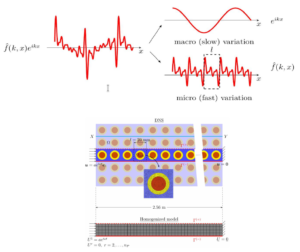
Nowadays, considerable progress is being made in the design of composite materials which can exhibit properties that are not found in naturally occurring materials. Numerical homogenization techniques are used in order to find effective properties of periodic microstructures at the macro-scale. In conventional homogenization methods, the material properties are averaged over a repeating Representative Volume Element (RVE) in order to calculate those effective properties. But in the case of elastodynamics, uniform volume averaging can lead to a loss of phase information which is necessary to accurately describe the elastodynamic material at the macro-scale. Such limitations can be overcome by transferring the microscale information to the Fourier space and then projecting the frequency modes to a reduced space composing a few selected Floquet-Bloch eigenmodes, thereby reducing the degrees of freedom at the macro-scale. The homogenized parameters can then be utilized in a material optimization setting, thus optimizing the dynamic properties of the structure.
Objective
To develop a multiscale method for elasto-dynamic simulation using homogenization in the Fourier domain.
Prerequisites
Good knowledge of numerics of partial differential equations, mathematical optimization, programming in MATLAB/Python/C++ and a lot of enthusiasm.
Language: English or German
Tasks
- Literature research
- Model development
- Numerical experimentation
- Writing thesis and dissemination of the results
Optimization of a Mechatronic Sensor
Maximizing the sensitivity and robustness of a mechatronic sensor through structural optimization.
In cooperation with a regional industry partner.
Tooth Root Optimization
Topology optimization of a tooth root. Attempt to compare evolution against structural optimization. For CE students who aren’t afraid of the dentist. 🙂
Solar Air Heater
Solar air heaters are fascinatingly simple, cheap and efficient devices for environmentally friendly ventilation and heating. Yet, solar air heaters are widely unknown in western countries.
Based on an existing numerical setup for a coupled flow/heat model, certain properties can be structurally optimized by means of gradient-based optimization.
HiWi jobs
We are constantly looking for dedicated students starting from Bachelor level to work on small scientific projects in our group. If you are interested in optimization, numerics and challenging applications and would like some income on a regular basis, please contact us. For students of mathematics and computational engineering.